Author: estebanf

  • Harnessing Intuition When Data Falls Short

    Data is at the core of modern product management. From feature prioritization to go-to-market strategies, we expect user insights, analytics, and measurable trends to back decisions. The ability to collect, analyze, and act on data separates strong product managers from those who rely on instinct alone. Yet, what happens when data is incomplete, inconsistent, or simply unavailable? Product managers must be able to rely on their intuition.

    Some of the most critical product decisions require a leap of faith. Emerging markets, disruptive technologies, and first-mover opportunities often lack historical data or clear precedent. Waiting for perfect information can mean missing out on a competitive advantage. In these moments, product managers must rely on intuition—shaped by experience, pattern recognition, and a deep understanding of users—to make informed yet decisive choices.

    I want to explore how product managers can effectively harness product management intuition when data is scarce. We’ll discuss real-world scenarios where relying on intuition is necessary, strategies for refining and strengthening intuitive decision-making, and techniques for confidently communicating these choices to stakeholders. The ability to balance data-driven insights with sound judgment sets great product leaders apart.

    Situations Where Product Managers Rely on Intuition

    Perfect data is a rare commodity that requires focus and discipline to collect and take advantage of. We all often face incomplete, conflicting or misleading information, even with a strong analytics practice in place. Here are some common scenarios where intuition plays a key role:

    1. Dealing with Incomplete or Biased Data

    Data-driven decision-making assumes access to high-quality data. However, small sample sizes, biased feedback, and incomplete datasets are part of a product manager’s day-to-day life. For example:

    • User surveys often reflect the opinions of the most engaged users, not the entire customer base.
    • A/B test results can be inconclusive if the sample size is too small.
    • Market research may be outdated or not fully representative of current trends.

    Product managers must use their experience and qualitative insights to bridge the gaps in these cases. Direct user conversations, usability tests, and behavioral observations help validate whether trends reflect real customer needs or are statistical noise. Read more about balancing data and empathy in product decisions.

    2. Navigating Conflicting Data

    If only it were as easy to have consistent results across different segments and test results. However, product managers often deal with contradictory information that creates uncertainty. If one data source suggests a feature is performing well while another highlights dissatisfaction, which should guide the next steps?

    Keeping in mind a strong product vision helps. Product managers need to:

    • Anchor decisions in the overarching strategy rather than getting lost in short-term data fluctuations.
    • Continuously revisit and refine hypotheses, assessing whether discrepancies stem from execution issues or flawed assumptions.
    • Consider qualitative factors, such as customer sentiment and competitive positioning, to supplement numerical insights.

    Understanding success metrics can help define clear decision-making criteria.

    3. Understanding Nuances in Customer Behavior

    Even with rich datasets, numbers alone don’t always explain the reasons behind user actions. Customers may abandon a feature not because it lacks value but because of friction in the experience. Metrics might show declining engagement, but it’s difficult to determine whether the issue is usability, messaging, or misalignment with user needs without qualitative input.

    To account for this, product managers:

    • Conduct in-depth user interviews and shadow real-world usage to understand intent.
    • Identify patterns in how customers interact with the product rather than just focusing on raw adoption metrics.
    • Cross-check behavioral data with customer support interactions and qualitative feedback to uncover root causes.

    Developing and Harnessing Product Management Intuition Effectively

    Intuition in product management is not inherent—it is developed through continuous learning, customer empathy, and structured decision-making. Here’s how product managers can refine and apply intuition effectively.

    1. Build Deep Customer Empathy

    Data provides insights, but direct engagement with customers builds intuition. Product managers should:

    • Spend time talking to users, observing their workflows, and understanding their frustrations.
    • Go beyond survey results to uncover real behavioral drivers.
    • Work closely with customer support and sales teams to identify patterns that might not be reflected in analytics.

    Empathy strengthens intuition by ensuring decisions are grounded in user needs rather than assumptions or incomplete datasets. Learn how aligning sales and product can improve customer insights.

    2. Use Structured Frameworks to Guide Intuition

    Intuition should not substitute structured thinking—it should complement it. Product managers can use proven frameworks to blend intuition with analysis. Two practical approaches include:

    • Jobs to Be Done (JTBD): This framework shifts the focus from product features to customer needs. By understanding what users are trying to accomplish, product managers can rely on intuition to fill gaps where data is lacking.
    • Intuitive Decision-Making Model: Decisions can be categorized as:
      • One-way door decisions (irreversible, requiring careful analysis).
      • Two-way door decisions (reversible, allowing for rapid iteration).

    By classifying decisions this way, product managers can apply intuition where it matters most—fast, iterative decisions—while being more data-driven on high-impact, irreversible choices.

    Communicating Intuitive Decisions to Stakeholders matters. 

    To gain stakeholder alignment, it is essential to communicate effectively how well-informed intuition-based decisions are. Here’s how product managers can ensure clarity, trust, and buy-in when relying on intuition.

    1. Translate Intuition into Business Outcomes

    Stakeholders, especially executives, care about the impact of their business. When communicating an intuition-driven decision, product managers should:

    • Frame the discussion around revenue growth, customer retention, or strategic differentiation.
    • Avoid technical jargon and instead connect the decision to measurable business goals.
    • Use analogies or past successful bets to reinforce credibility.

    2. Encourage Open Dialogue and Feedback

    Intuition-driven decisions can be met with skepticism. Encouraging open discussions helps build alignment. Product managers should:

    • Invite stakeholders to challenge assumptions and provide alternative viewpoints.
    • Be transparent about areas of uncertainty and explain why a decision still makes sense.
    • Actively listen to concerns and adjust strategies if valid counterpoints arise.

    3. Document and Articulate Rationale Clearly

    Product managers should document their reasoning to provide transparency even when intuition plays a role. This can be done through:

    • Decision memos outlining key considerations, risks, and expected outcomes.
    • Hypothesis-driven frameworks that explain why a direction was chosen.
    • Regular progress and results updates show that intuition-based decisions are continuously validated.

    Conclusion

    Intuition is essential in a product manager’s decision-making arsenal, especially when data is incomplete or conflicting. The best product leaders balance product management intuition with structured analysis, ensuring that experience and judgment complement data-driven insights.

    Product managers can develop reliable intuition by committing to continuous learning, fostering deep customer empathy, and using structured frameworks. Communicating these decisions effectively—translating them into business outcomes, fostering open discussions, and documenting rationale—ensures stakeholder trust and alignment.


    Ultimately, great product managers don’t just follow data; they know when to trust their instincts and make confident decisions that drive impact.

     

  • Thought exercise: Improving Candidate Experience in ATS with AI-Powered Resume Parsing

    Applying for a job is already an emotionally charged process. Candidates invest hours refining their resumes, crafting compelling cover letters, and gathering supporting materials—only to encounter an Applicant Tracking System (ATS) that treats them as data-entry clerks rather than potential hires.

    Today’s ATS platforms, used by companies of all sizes, offer a subpar user experience that introduces unnecessary friction into the hiring process. As they prioritize HR compliance and recruiter efficiency, they neglect the candidate experience entirely. This leads to frustration, disengagement, and even talent attrition before the hiring begins.

    Most ATS, like Workday, Dayforce, Taleo, or iCIMS, force candidates to:

    • Create a user account before even starting the application process.
    • Upload documents like resumes and cover letters.
    • Enter personal data, often beyond what is necessary, such as requiring a full home address.
    • Experience incorrect parsing that repopulates sections such as experience, education, and skills inaccurately, forcing candidates to review, remove, and manually correct errors before submitting.

    Other systems, such as Greenhouse or Bamboo, provide a more modern experience. However, candidates have no clear indication of whether the system is correctly reading their resumes.

    Nowadays, the consensus is that candidates must tailor their applications to each job post, with recommendations suggesting at least 30 minutes per application. In 2025, 58% of the workforce will seek a job. At this scale, improving the candidate experience and reducing the time required to apply for a job translates to massive savings of wasted time.

    The Candidate’s Pain Points

    1. Repetitive Data Entry
      • After uploading a resume, the chances that the ATS correctly extracted the work history, education, and skills are slim. Candidates then have to take on a reviewer/editor job to ensure the information is correctly captured, usually by copying and pasting what’s in their resume. This inefficiency signals a disregard for candidates’ time.
    2. Limited Flexibility for Candidates
      • Candidates cannot clarify or expand upon critical qualifications even when parsing works correctly. If an important skill or project isn’t explicitly stated in their resume, the ATS won’t surface it. For the candidate, it becomes a game of guessing and hoping for the best.
    3. Lack of Empathy in the Process
      • Hiring is fundamentally about people. Yet, most ATS interactions feel mechanical, prioritizing recruiter convenience over candidate experience. This is a classic example of what I’ve discussed before: product teams must combine data-driven efficiency with user empathy to create meaningful solutions. In a time when AI-driven applications are simplifying complex workflows across industries, there is no excuse for forcing applicants to navigate outdated, cumbersome interfaces that strip away the human element of hiring.

    Do you want to learn more? Check out r/recruitinghell, which has hundreds of daily messages highlighting candidates’ struggles today.

    Why This Problem Matters

    The consequences of a flawed ATS experience extend beyond candidate frustration:

    • Higher Drop-Off Rates: Lengthy, tedious applications deter top talent, particularly in competitive fields where candidates have multiple job options.
    • Poor Employer Branding: A frustrating application process leaves a negative impression of the company before the first interview.
    • Inefficiency for Recruiters: If the ATS fails to extract and present relevant qualifications accurately, recruiters must spend additional time manually reviewing applications.
    • Missed Opportunities: Companies risk overlooking qualified candidates simply because their ATS couldn’t interpret their resumes correctly. A candidate with 10+ years of experience in Python may be ignored simply because the ATS didn’t recognize their skills in an unconventional resume format.

    A Modern Solution is Long Overdue

    With the rise of AI-driven automation, these inefficiencies are no longer justifiable. A more intelligent, empathetic approach to ATS design—one that balances candidate experience with recruiter efficiency. All it takes for companies to bring these systems to market is to consider candidates as meaningful stakeholders to attend to.

    If I were in a position to rethink the candidate experience, this is the PRD I would use to start the conversation:

    Product Requirements Document (PRD)

    Objective

    • Improve data extraction and candidate experience by reducing redundant manual entry.
    • Ensure better decision-making for recruiters by surfacing relevant qualifications in a structured manner.

    User Stories & Use Cases

    • As a candidate, I want my resume and cover letter to be automatically and correctly parsed so I don’t manually enter redundant information.
    • As a candidate, I want to review and edit extracted information to ensure accuracy.
    • As a candidate, I want the opportunity to add clarifying information about my skills and experience if my resume does not fully reflect my qualifications.
    • As a recruiter, I want a structured summary of candidates’ qualifications mapped to job requirements.

    Key Features & Functionalities

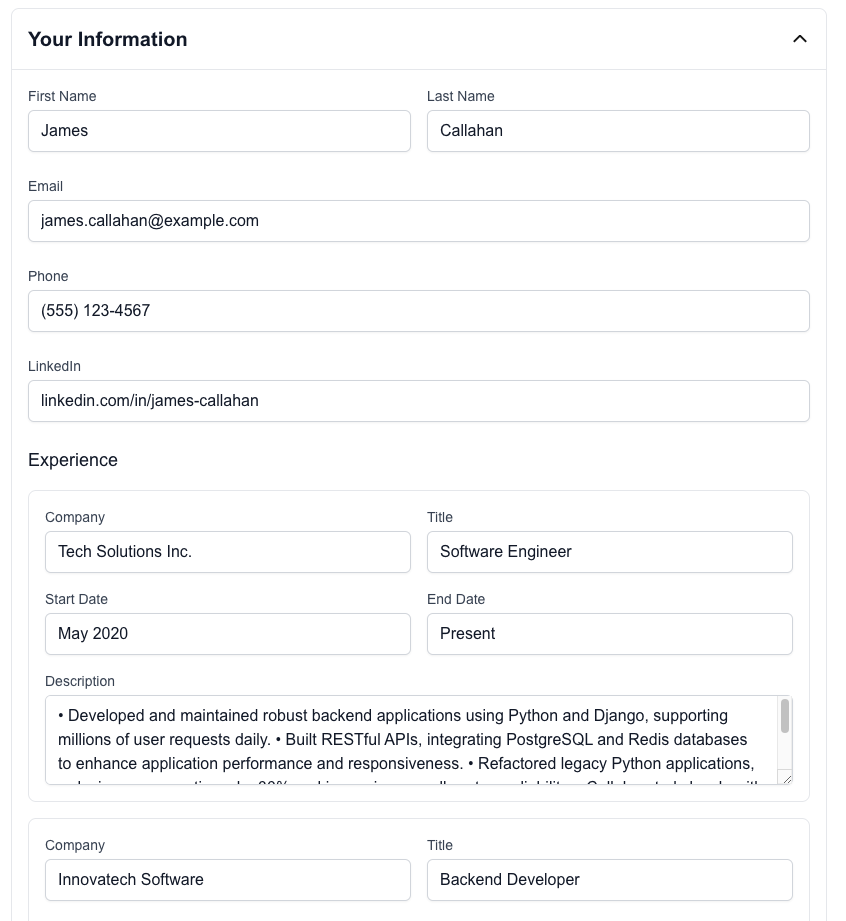
    • LLM-powered Resume & Cover Letter Parsing
      • Automatically extracts work experience, education, skills, and achievements.
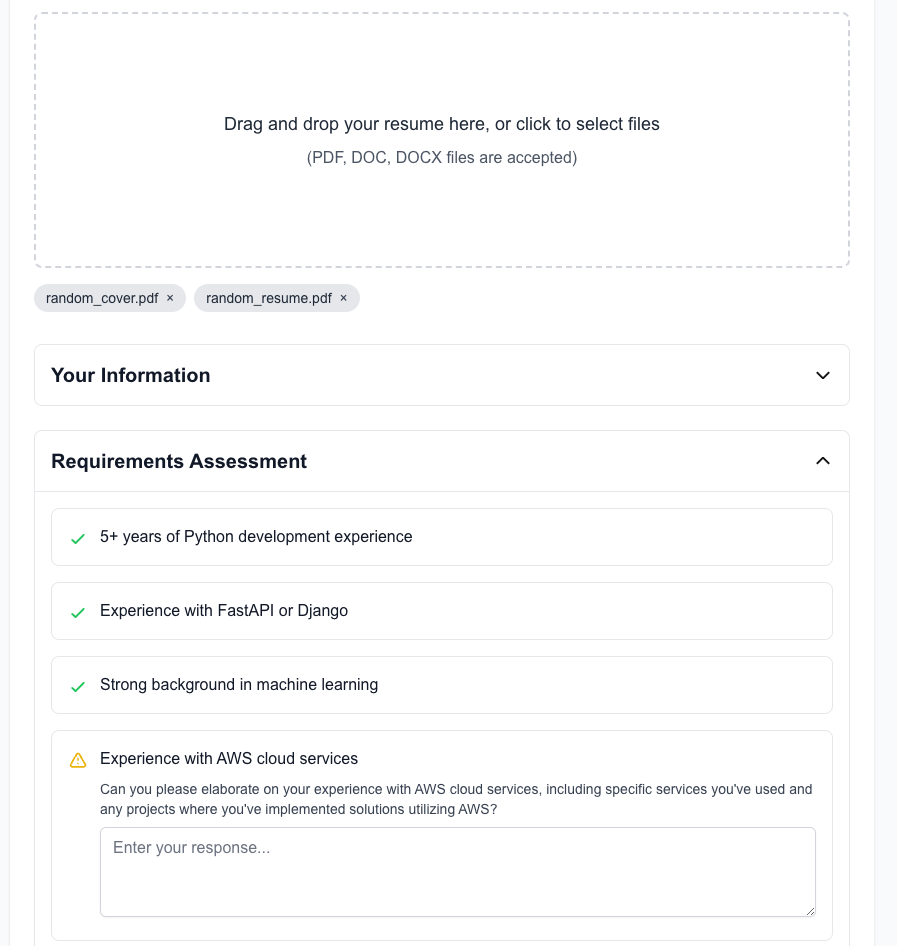
    • Qualification Mapping
      • Compares parsed data against job requirements.
    • Candidate Self-Validation & Enhancement
      • Allows candidates to supplement missing details to strengthen their application.
    • Recruiter Dashboard
      • Provides structured, enriched profiles for quick assessment.

    Success Metrics

    • Reduction in time spent on candidates filling out manual forms.
    • Increased accuracy of candidate profiles.
    • Improved recruiter efficiency in assessing applicants.

    Prototype

    Process

    Technology

    • Haystack to implement the pipelines to read the documents, extract data, and perform assessments.
    • FastAPI-based web service.
    • A Next.js web app to mock the prototype.

    Code for the service is available at https://github.com/estebanf/better_ats_service

    Experience

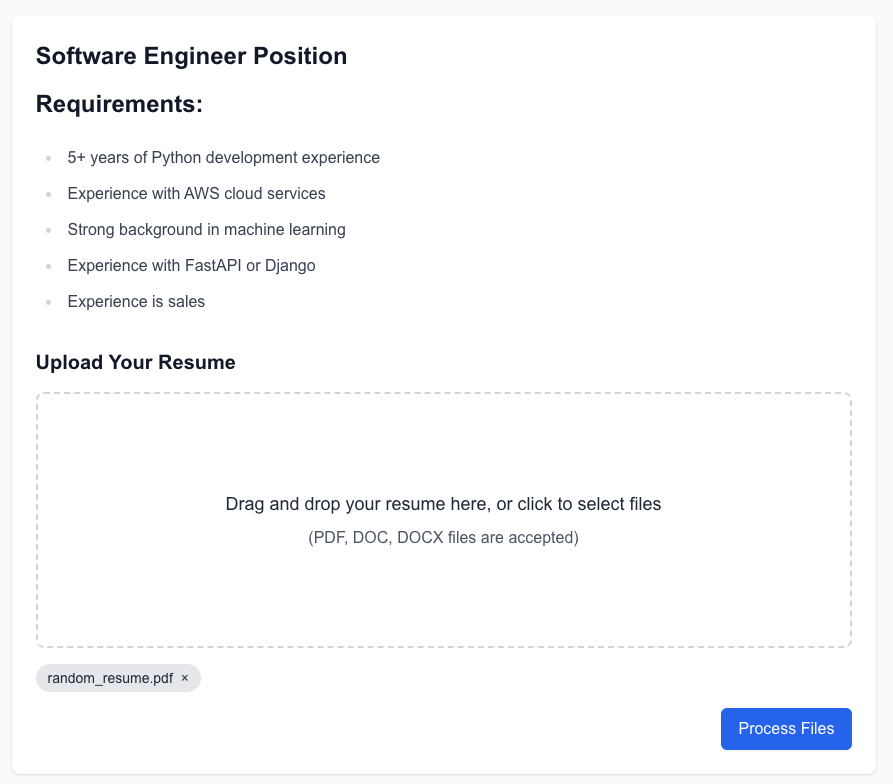
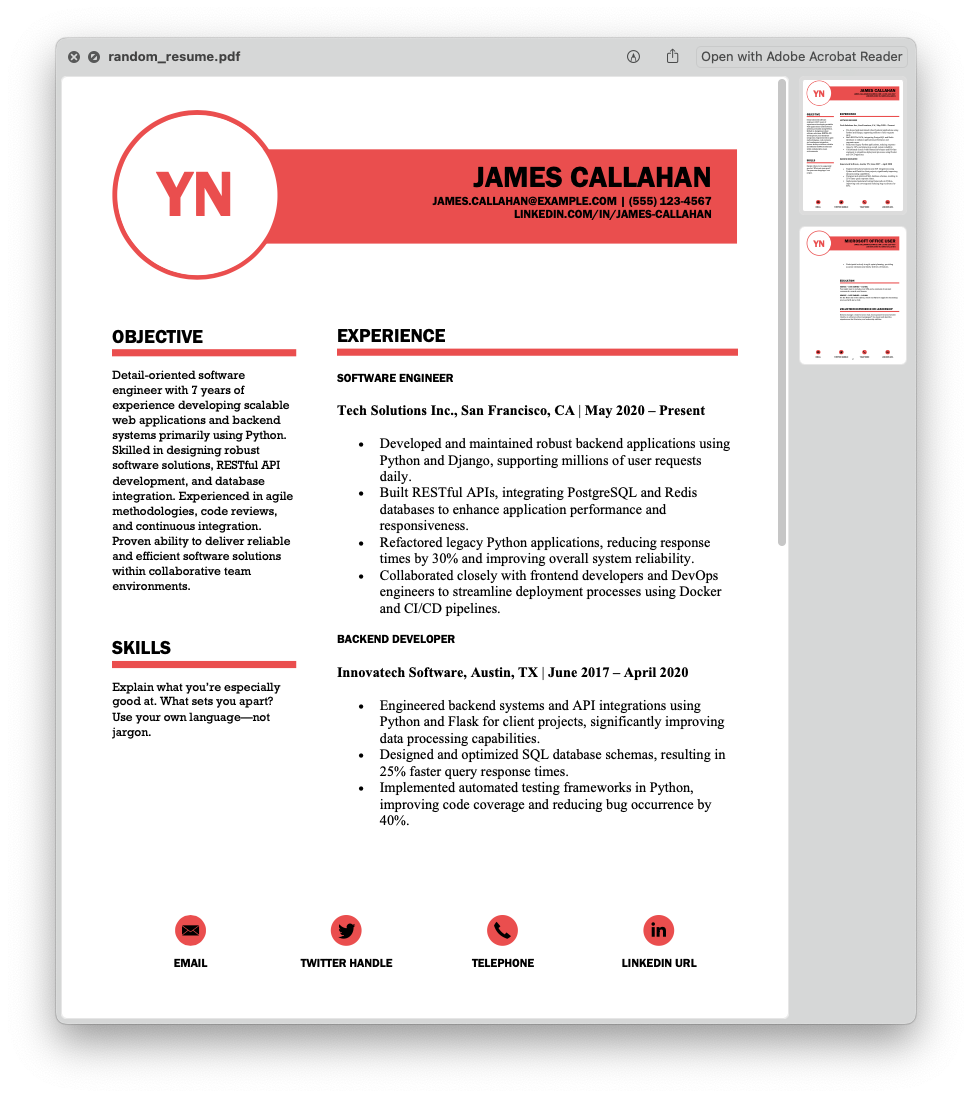
    We’ll assume the candidate is a software developer. In their resume, they have references to experience with Python. The cover letter mentions they had worked on machine learning projects. Both documents use Microsoft Word templates and are rendered as PDF files.


    The job opportunity calls for these experiences

    • 5+ years of Python development experience
    • Experience with AWS cloud services
    • Strong background in machine learning
    • Experience with FastAPI or Django
    • Experience is sales

    So, the candidate submits their resume

    Using a small model like GPT-4o-mini, we can get better extraction than most ATS will do when resumes have styled formats like the used resume.

    The ATS would also ask questions about those requirements that can’t reasonably be determined by reading the documents.


    If the candidate had submitted their resume and cover letter, the service would have found references to their machine learning experience and marked that requirement as met.

    As a candidate, an experience like this is efficient and relevant. It would help them provide additional information to highlight why they are a good candidate, or it would have helped them realize there are gaps between their background and the job post.

    This process could feed recruiters with more accurate and relevant data for their evaluation and assist them in making more informed decisions when deciding whether engaging with a candidate makes sense.

    Conclusion & Key Learnings

    Technology should solve problems, not create new ones. The most effective products stem from deep user empathy, ensuring candidates and recruiters benefit from AI-driven improvements. By prioritizing user experience, ATS vendors could create a smoother application process and strengthen the quality of hiring decisions.

    Furthermore, AI-driven solutions have real, tangible applications in workflow automation. When used correctly, they don’t just replace manual processes—they enhance them, enabling candidates and recruiters to focus on what truly matters: finding the right fit.

  • Sales Meets Product: Aligning for Happier Customers

    Do these sound familiar: “Sales just makes crazy promises” or “Just give me a product I can actually sell”? It feels like we’ve all heard them before. The thing is, for a company to really deliver amazing outcomes for customers, sales and product teams need to work together effectively. So, why is that often so tough?

    Well, it usually comes down to the fact that these teams have different goals, workflows, and what they prioritize. To really close that gap, it’s all about fostering respect for each other, having a clear understanding of roles, and aligning strategies around shared goals that keep the customer at the center. When that happens, everyone wins!

    In this post, we’ll unpack exactly why collaboration between sales and product teams is essential, what it takes to build lasting trust, and how overcoming common barriers can dramatically improve your customer outcomes.

    Understanding Roles and Responsibilities

    Before teams can effectively collaborate, clarity around roles is critical. The confusion here spells disaster: missed opportunities, redundant efforts, and inevitable frustration.

    Sales Team Responsibilities:

    • Identifying potential customers and qualifying leads.
    • Understanding customer needs through direct interactions.
    • Positioning and communicating product value.
    • Negotiating contracts and closing deals.
    • Driving revenue and growth targets.

    Product Team Responsibilities:

    • Conducting market analysis and gathering customer insights.
    • Defining product strategy and managing roadmaps.
    • Collaborating with engineering for product development.
    • Ensuring usability, scalability, and product quality.
    • Aligning offerings with broader business objectives.

    Clear role definitions foster smoother interactions. Sales bring invaluable frontline insights about customer pain points. Meanwhile, the product team equips sales with the deep product knowledge they need to effectively communicate value.

    Building Mutual Respect and Trust

    Trust doesn’t happen overnight. It takes intention, transparency, and empathy. Without mutual respect, collaboration falls apart quickly.

    Open Communication and Shared KPIs

    Effective collaboration between sales and product teams requires ongoing transparency. Regular meetings, clearly documented feedback loops, and shared KPIs—such as customer retention and revenue growth—are critical to maintaining alignment. Clear success metrics help teams avoid ambiguity, ensuring everyone remains focused on customer outcomes.

    Involve Both Teams Early

    Collaboration must start early. Engaging both teams in planning sessions helps align priorities, set realistic expectations, and preempt potential roadblocks. This early alignment not only streamlines decision-making but builds a sense of shared ownership and teamwork.

    Recognize Contributions Openly

    Acknowledging each team’s unique contributions fosters trust. Product teams need recognition for crafting viable, impactful products; sales teams deserve credit for the difficult task of customer acquisition and relationship management. Celebrating joint successes reinforces a culture of appreciation and trust.

    Addressing Common Barriers to Collaboration Between Sales and Product Teams

    Despite best intentions, barriers inevitably emerge:

    • Differing Priorities: Sales teams may chase immediate revenue, while product teams aim for long-term impact.
    • Communication Gaps: Without structured exchanges, vital information gets lost.
    • Siloed Workflows: Teams operating independently leads to inefficiencies and misalignment.
    • Limited Visibility: A lack of transparency makes aligning efforts challenging.

    Here’s how you tackle these barriers:

    • Establish shared objectives that balance immediate sales goals with long-term product strategy.
    • Enhance communication channels with regular alignment meetings and accessible documentation.
    • Create integrated workflows—shared roadmaps and project management tools keep everyone on the same page.
    • Foster continuous learning by encouraging teams to understand each other’s roles and challenges.
    • Reward collaboration explicitly through team recognition and incentives.

    How Collaboration Between Sales and Product Teams Impacts Customer Success

    When sales and product teams align closely, customers feel the difference. Tailored approaches to customer retention become achievable. Teams anticipate customer needs accurately, product enhancements reflect genuine market demands, and sales strategies resonate more deeply.

    Organizations prioritizing collaboration experience:

    • Higher customer retention rates
    • Increased revenue and faster deal cycles
    • Improved customer satisfaction and brand loyalty

    Teamwork isn’t just a nice-to-have; it’s a strategic imperative. By combining empathy with data-driven insights, teams ensure that customer-centric strategies genuinely meet user needs.

    Embracing a Collaborative Future

    Effective collaboration between sales and product teams is more than just cooperation—it’s a strategic alignment that drives meaningful customer and business outcomes. Organizations that foster mutual respect, clearly define roles and proactively dismantle barriers will thrive in competitive markets.

    Now is the perfect moment to prioritize collaboration. When your sales and product teams speak the same language, supported by clear success metrics and shared goals, your business becomes unstoppable. Take these steps today to ensure your organization is aligned, agile, and ready to deliver exceptional value to customers.

  • The Role of Product Managers in Defining Success Metrics

    Success in product management isn’t just about shipping features—it’s about delivering meaningful business impact. Success metrics in product management provide the clarity needed to evaluate whether a product or feature is truly moving the needle. Without clear metrics, teams risk optimizing for outputs rather than outcomes, making it difficult to gauge progress or adjust strategy effectively.

    Why Product Managers Must Own Success Metrics

    Product Managers are at the intersection of customer needs, business strategy, and engineering execution. To ensure alignment across these dimensions, they must define, track, and iterate on success metrics that reflect both short-term wins and long-term viability. Whether measuring feature adoption, customer satisfaction, or revenue impact, the right metrics enable better prioritization, improved stakeholder communication, and more data-driven decision-making.

    Defining Success Metrics in Product Management: The Product Manager’s Toolkit

    Success metrics aren’t one-size-fits-all. A well-structured approach requires breaking down business goals into product-level KPIs that map directly to customer and user behaviors. KPI trees are an effective tool for connecting high-level objectives to actionable insights. Instead of tracking everything, Product Managers should focus on key moments that define the product experience—like onboarding, retention, and feature adoption.

    For instance, rather than just looking at feature activation rates, PMs should measure:

    • First-use adoption: How many eligible users engage with the feature within four weeks?
    • Sustained usage: What percentage continue using it beyond the initial interaction?

    This approach shifts focus from simply launching features to ensuring they deliver real value.

    Articulating Success Metrics for Collaborative Success

    Metrics are only as useful as how well they are communicated. Product Managers must ensure that success criteria are understood across engineering, design, marketing, and executive leadership. Instead of relying on technical jargon, framing success in terms of business impact—like profitability, retention, and operational efficiency—helps drive alignment and stakeholder buy-in.

    A strong PM doesn’t just track metrics but weaves them into compelling narratives:

    • Revenue Impact: “By refining our onboarding flow, we increased first-month retention by 15%, leading to a $2M projected annual revenue boost.”
    • Operational Efficiency: “Reducing platform complexity led to a 20% decrease in support tickets, allowing us to allocate more resources to innovation.”

    Connecting data to real-world outcomes makes success metrics actionable and ensures they are central to strategic discussions.

    The Impact of Well-Defined Success Metrics in Product Management on Product Development

    A metrics-driven approach directly shapes product development. Clear success criteria help:

    • Prioritize work: Teams focus on initiatives with measurable business impact.
    • Improve iteration: Feedback loops based on actual usage data guide refinements.
    • Reduce risk: Tracking leading indicators prevents investments in low-impact features.

    Equally important are UX-driven success metrics, which complement business KPIs. Metrics such as task completion time and customer effort scores provide insights into usability and experience, ensuring that products aren’t just functional but intuitive and engaging.

    Overcoming Challenges in Setting Success Metrics

    Product Managers often struggle with:

    • Lack of a clear baseline: Without an initial benchmark, measuring improvement is difficult.
    • Conflicting priorities: Balancing growth, retention, and revenue requires thoughtful trade-offs.
    • Vanity metrics: Tracking engagement without tying it to meaningful outcomes can be misleading.

    To avoid these pitfalls, Product Managers should:

    • Set clear pre-launch benchmarks for every initiative.
    • Use a balanced mix of metrics to prevent over-optimization of one goal at the expense of others.
    • Continuously refine and iterate based on new insights and business needs.

    Conclusion

    Defining and tracking success metrics in product management is critical for product leaders who want to build impactful, scalable products. Success isn’t about launching features—it’s about driving meaningful business and customer outcomes. By focusing on well-structured metrics, communicating their importance effectively, and iterating based on data-driven insights, Product Managers can lead their teams toward sustainable success.

    As organizations become increasingly data-driven, PMs who master success metrics will stand out as strategic leaders, ensuring that every product decision contributes to measurable growth and long-term impact.

  • Leveraging Financial Metrics in Product Management for Smarter Decisions

    In the fast-paced world of product management, reacting to feature requests from sales teams, customer feedback, and market trends is common. While these inputs provide value, without a structured approach, teams can quickly fall into a reactive cycle. An unchecked, reactionary approach leads to bloated roadmaps, misaligned priorities, and wasted development efforts.

    The real challenge isn’t just deciding which features to build—it’s identifying which investments will have the greatest strategic and financial impact. This is where financial metrics in product management come into play. By prioritizing based on revenue potential, cost efficiency, customer lifetime value, and other key indicators, product managers can shift from reactive execution to proactive decision-making. Instead of chasing individual requests, they can focus on initiatives that align with long-term business objectives and sustainable growth.

    The Importance of Financial Acumen in Product Management

    Great product decisions aren’t just about building features users love—they’re about making choices that drive business success. Product managers must develop financial acumen and understand how cost structures, pricing models, and revenue streams impact the company’s bottom line to do this effectively. Without this knowledge, even the most innovative products can struggle to achieve sustainable growth.

    Key financial literacy areas for product managers include:

    • Cost Structures: Understanding fixed costs (e.g., infrastructure, salaries, licensing fees) vs. variable costs (e.g., customer support, cloud usage, transaction fees) enables better scalability and profitability decisions.
    • Pricing Models: Subscription-based, usage-based, and tiered pricing have different financial implications. Aligning pricing strategies with customer behavior and perceived value is crucial.
    • Key Financial Metrics: Metrics like customer acquisition cost (CAC), customer lifetime value (CLV), and gross margin provide insights into product viability and long-term sustainability.

    By developing financial acumen, product managers elevate their role from tactical execution to strategic leadership. This transformation allows them to make data-driven decisions that optimize resources and maximize impact, ensuring their initiatives align with broader business objectives. This shift enables them to allocate resources efficiently, justify investments with data-backed insights, and make informed trade-offs between growth and profitability. For example, understanding customer lifetime value (CLV) can help prioritize features that drive long-term retention rather than short-term engagement. They gain the ability to speak the language of executives, influence key business decisions, and ensure their product strategy contributes to sustainable growth.

    Proactive Product Strategy Through Financial Metrics

    Product management requires balancing immediate customer needs with a long-term strategic vision. While it’s crucial to remain responsive, a structured approach ensures that product initiatives contribute to sustained growth rather than short-term fixes. Without a structured approach, teams risk falling into reactive development—building features that satisfy short-term demands but fail to create lasting business value. Financial metrics help product managers critically evaluate feature requests, ensuring that every initiative supports strategic and financial goals.

    Key questions to assess feature requests:

    • Why does the customer need this?
    • What business problem does it solve?
    • How does it align with our product vision?

    Feature requests often indicate underlying challenges rather than standalone solutions. Addressing these root causes leads to more scalable and impactful product decisions and enables teams to develop scalable and impactful alternatives.

    Using financial metrics for structured evaluation:

    • Opportunity Cost Ratios: Weigh trade-offs by assessing required resources (e.g., X engineers * Y weeks = Z impact).
    • Feature Triage Frameworks: Categorize requests into Now, Next, or Never to prioritize based on business impact rather than urgency.
    • ‘Not Doing’ List: Maintaining a clear rationale for deprioritized initiatives prevents roadmap bloat and keeps focus on strategic goals.

    Financial dashboards should explicitly map product investments to measurable business outcomes, tracking:

    • Customer Acquisition Cost (CAC)
    • Customer Lifetime Value (CLV)
    • Revenue Contribution
    • Operational Efficiency Gains

    By leveraging these insights, product managers can transition decision-making from gut instinct to data-driven strategies that drive sustainable growth.

    Aligning Product Management with Organizational Goals

    An excellent product strategy goes beyond building innovative features. It ensures that every decision directly supports broader business objectives, creating sustainable value rather than incremental improvements. Product managers who understand their organization’s business model, revenue streams, and financial constraints can make informed choices that drive product success and sustainable growth.

    To ensure alignment, product managers must:

    • Engage with key business insights through shareholder reports, executive town halls, and financial performance metrics.
    • Use data-driven dashboards to connect strategic investments to business outcomes, ensuring visibility into trends and progress.
    • Balance long-term vision with agile execution, structuring an annual roadmap with quarterly adaptability to respond to market shifts while maintaining focus.

    Overcoming Challenges in Using Financial Metrics

    While financial metrics are potent tools for strategic decision-making, misalignment, unclear success criteria, and over-reliance on rigid frameworks can lead to misleading conclusions. Product managers must focus on meaningful outcomes to truly harness financial metrics rather than just tracking numbers.

    Best practices to overcome these challenges:

    • Define Clear Success Metrics: Establish benchmarks before launch and track progress against leading indicators like adoption rate, revenue growth, and retention.
    • Prioritize First Principles Thinking: Frameworks like RICE, MoSCoW, or Kano can be helpful in structuring prioritization and decision-making, especially for large teams or complex product portfolios. For example, RICE scoring can help rank high-impact initiatives, while MoSCoW can assist in distinguishing must-have features from lower-priority enhancements. However, rigid adherence to these frameworks can sometimes overlook unique business contexts, requiring a balance of structure and judgment. However, they shouldn’t replace critical thinking, as rigid reliance on these models can sometimes lead to misguided priorities or missed opportunities for innovation. Product managers should ask, “What problem are we solving? What’s the real business impact? What happens if we don’t build this?”
    • Shift Towards Financially-Driven Product Management: With today’s emphasis on profitability over hypergrowth, product managers must demonstrate financial impact through revenue generation, cost savings, and operational efficiencies.

    Conclusion: The Power of Financial Metrics in Product Management

    In today’s competitive landscape, product managers must do more than build great products—they must make strategic decisions that drive business success. Financial acumen is essential for understanding cost structures, pricing models, and the long-term impact of product investments. By integrating financial metrics in product management**, teams can move beyond reactive development and focus on initiatives that create sustainable value.

    proactive, metrics-driven strategy ensures that every product decision is made with a clear understanding of its financial and strategic implications. Instead of prioritizing features based on urgency or stakeholder pressure, product teams can use data-driven frameworks to assess opportunity costs, measure expected impact, and allocate resources effectively.

    Ultimately, successful product management is about alignment—ensuring that product development prioritizes features that drive user engagement and revenue growth rather than focusing solely on stakeholder requests.—between product initiatives and business objectives, between short-term execution and long-term vision, and between customer needs and financial sustainability. Organizations can achieve sustained growth and market leadership when product teams, sales, marketing, and customer success operate with shared goals and a unified strategy.

    By leveraging financial metrics as a guiding force in product management, product managers can elevate their role from tactical executors to strategic leaders. This shift ensures that every product decision contributes meaningfully to customer success and business profitability, creating a measurable impact on long-term growth.

  • The Balance of Empathy and Data in Product Management

    Great product managers don’t rely solely on intuition or make decisions solely based on data. Instead, they strike a careful balance, blending user empathy with analytics to drive informed, impactful choices. Empathy helps uncover user frustrations, motivations, and unmet needs, while data provides the validation and prioritization framework to ensure the correct problems are addressed at the right time.

    Achieving this balance isn’t always easy. Leaning too heavily on qualitative insights can lead to anecdotal-driven decisions that don’t scale. Conversely, an overemphasis on data risks reducing users to numbers, stripping away the nuance of real-world experiences. Product managers must integrate both perspectives—combining customer conversations, support tickets, and user interviews with A/B test results, engagement metrics, and retention data.

    This post explores how successful product teams bridge this gap. From leveraging customer insights to inform roadmaps to applying data-driven prioritization without losing the human element, we’ll dive into strategies that ensure empathetic and analytically sound product decisions.

    The Role of Empathy in Product Management

    At its core, product management is about solving real problems for real people. Empathy enables product managers to go beyond surface-level data and deeply understand user frustrations, motivations, and needs. It’s not just about tracking user behavior—it’s about grasping why they act the way they do and how their experiences shape expectations.

    • Identify Emotional Drivers: Look for underlying motivations and frustrations during user interviews.
    • Observe Real-World Context: Shadow support calls or participate in customer onboarding to witness first-hand barriers and pain points.
    • Build Authentic Connections: Encourage open dialogue and show genuine interest in user feedback to foster trust.

    Empathy helps uncover pain points that analytics alone might miss. By stepping into the user’s shoes, product managers can design solutions beyond functionality to create intuitive, meaningful experiences. Without this depth of understanding, even well-intentioned features can fall flat, leading to low adoption or unintended friction.

    Cultivating empathy requires direct user engagement. While dashboards provide valuable insights, they can’t replace firsthand interactions. Speaking with customers, shadowing support teams, listening to sales calls, and observing real-world usage reveal nuances that data alone won’t surface. These interactions build intuition and uncover hidden pain points that impact product success.

    A significant risk in modern product management is reducing users to data points. When decisions are purely metrics-driven, the human experience can be overlooked:

    • A decline in retention could stem from a usability issue rather than poor product-market fit.
    • A sudden drop in engagement might indicate frustration rather than disinterest.

    By staying connected to users, product managers ensure they aren’t just optimizing metrics but genuinely improving experiences. Ultimately, successful product teams blend analytical rigor with deep customer understanding. Empathy helps identify the correct problems to solve, while data ensures they prioritize effectively. The following section explores how product managers can harness data to complement these insights and make informed decisions.

    Leveraging Data for Informed Decision-Making

    While empathy helps product managers identify meaningful problems, data ensures they focus on solving the right ones at the right time. With limited resources and inevitable trade-offs, prioritization is key, and data provides the clarity needed to concentrate on the highest-impact opportunities.

    • Behavioral Analytics: Study engagement metrics, conversion funnels, and retention data to understand user trends.
    • Feature Adoption Rates: Identify which features resonate most with users and which ones need improvements.
    • A/B Testing: Validate hypotheses and refine product strategy with measurable experiments.

    Successful product managers don’t rely on single customer anecdotes to drive decisions. While user stories offer valuable context, broader trends should guide prioritization across multiple customer interactions. A single frustrated customer may surface a problem, but when the same frustration appears across hundreds or thousands of users, it becomes a priority worth solving.

    As digital products scale, direct user observation becomes impractical. Product managers must think like analysts, leveraging structured data to guide decisions rather than relying solely on instinct. This is where product analytics platforms, A/B testing frameworks, and feedback aggregation systems become invaluable for extracting insights, validating hypotheses, and measuring success.

    Product managers balance empathy with data to ensure their decisions drive meaningful impact. In the next section, we’ll explore how this balance plays out in real-world product development, showcasing the power of a holistic approach.

    Integrating Empathy and Data for Effective Product Management

    Balancing empathy and data isn’t about choosing one over the other—it’s about knowing when and how to leverage both. The best product managers seamlessly integrate qualitative insights with quantitative analysis, adapting their approach based on the scale and nature of their business.

    • Large-Scale Operations: Analytics often drive decision-making when statistically significant data is abundant.
    • Early-Stage Initiatives: Where data is sparse, startups rely more on qualitative insights like interviews and focus groups.
    • Mixed-Method Approach: Use empathy to identify issues and data to confirm scope and impact.

    A common challenge in integrating these perspectives is ensuring qualitative research isn’t lost in the sea of data. Valuable customer interviews and feedback sessions often end up in repositories, disconnected from decision-making. To prevent this, product teams should:

    1. Synthesize Insights: Convert lengthy reports into concise, actionable takeaways.
    2. Centralize Findings: Create a knowledge hub combining qualitative feedback with adoption metrics.
    3. Establish Continuous Feedback Loops: Monitor user needs continuously through regular customer conversations and real-time data monitoring.

    Many successful companies illustrate this balance in action. Airbnb, for example, used empathy to refine its experience when data alone failed to explain low engagement. By observing hosts struggling with poor-quality photos, they introduced a professional photography program, which led to higher bookings and improved platform trust. Meanwhile, Spotify blends qualitative feedback with data-driven insights to refine its recommendation algorithms, ensuring user sentiment and engagement metrics guide product evolution.

    Ultimately, great product managers master the ability to switch perspectives. They use empathy to uncover the correct problems and data to prioritize those that drive the most significant impact. By embracing both, teams create well-optimized products that deeply resonate with users.

    Conclusion and Key Takeaways

    Outstanding product management isn’t purely data-driven or entirely intuition-based—it thrives at the intersection of empathy and analytics. Understanding user needs through direct interactions and qualitative insights is essential for identifying meaningful problems and designing solutions that truly resonate. However, product teams risk focusing on issues that may not drive the most significant impact without data to validate and prioritize these insights.

    Key Takeaways

    • Empathy First: Empathy helps product managers identify pain points and connect deeply with user needs.
    • Data Validation: Data offers the framework to measure the scope and impact of those needs, ensuring high-priority items receive the right focus.
    • Continuous Integration: Combining qualitative and quantitative insights allows teams to refine strategies iteratively.
    • Strategic Balance: Empathy keeps products human-centric, while data-driven decisions ensure efficiency and measurable success.

    By integrating both perspectives, product managers make more intelligent, informed decisions. Empathy keeps products user-centric, while data provides the structure to assess trade-offs, optimize resources, and measure success. The most effective teams build mechanisms to bridge this gap, combining customer interviews with behavioral analytics, maintaining structured knowledge repositories, and establishing continuous feedback loops for qualitative and quantitative insights.

    Ultimately, the best product decisions result from a thoughtful balance of human understanding and analytical rigor. By mastering this integration, product managers can create functional, efficient, and deeply meaningful products to their users.

  • Wireframes as a Tool for Bridging Product Management and Engineering

    In today’s fast-paced product development landscape, seamless communication between product management, engineering, and design teams is critical. While teams rely on documentation, meetings, and written specs to stay aligned, these methods often fall short—leading to misinterpretations, delays, and technical blockers that surface too late.

    Wireframes offer a simple yet powerful solution. As lightweight visual tools, they strip away unnecessary complexity, allowing teams to focus on structure, functionality, and user experience before committing to detailed designs or technical execution. Unlike dense requirement documents, wireframes create a shared visual language that product managers, designers, and engineers can use to quickly align on what’s being built and why.

    Wireframes help teams identify potential roadblocks early, refine ideas collaboratively, and maintain clarity across all stakeholders—from executives to developers- by bridging the gap between high-level customer value and technical feasibility. This post will explore how wireframes drive alignment, reduce misunderstandings, and streamline the product development process.

    Understanding Wireframes and Their Role

    Wireframes are more than just rough sketches—they are structured visual tools that help teams define a product’s layout, functionality, and user flow before committing to detailed design or development. Stripped of colors, branding, and intricate UI elements, wireframes keep the focus on the essentials: what the product does, how it works, and how users interact with it.

    At their core, wireframes serve as a shared language between product managers, designers, and engineers. They translate abstract ideas into concrete structures, making it easier to align on core functionality without getting distracted by visual details too soon. By providing a clear blueprint, wireframes reduce the risk of misinterpretation from written documentation alone, ensuring all stakeholders share a unified vision.

    Beyond aiding design, wireframes facilitate cross-functional collaboration. Product managers use them to communicate business requirements and user needs, designers refine user experience decisions, and engineers assess technical feasibility early on. This shared reference point streamlines discussions, minimizes back-and-forth, and leads to more informed decision-making—ultimately driving a product that balances business goals with technical constraints.

    Wireframes as a Solution to Communication Challenges

    Misaligned expectations, vague requirements, and late-stage technical blockers often hinder collaboration between product management, engineering, and design teams. A common issue is that engineers are brought into discussions too late, leading to feasibility concerns that could have been addressed earlier. Meanwhile, product managers may struggle to translate high-level business goals into actionable technical requirements, and designers may find it challenging to balance usability needs with engineering constraints. These gaps create inefficiencies, rework, and frustration across teams.

    Wireframes provide a practical solution by offering a clear, visual representation of product functionality before development begins. Unlike lengthy documentation or abstract discussions, wireframes clarify intent and reduce ambiguity. By mapping out key elements and user interactions in a straightforward format, they enable engineers to assess feasibility early, product managers to validate core requirements, and designers to refine user flows—all before significant resources are invested.

    Involving design teams in wireframing further strengthens alignment. Designers bring expertise in user experience and interface best practices, ensuring wireframes are functional and intuitive for end users. Early collaboration between engineering and design teams helps identify technical constraints, explore alternative solutions, and prevent last-minute redesigns.

    Wireframing is most effective as a shared activity rather than a UX-exclusive task. Encouraging product managers and engineers to contribute fosters open collaboration and leads to more cohesive solutions. Whether created collaboratively in real-time using cloud-based tools or supplemented with annotations and walkthroughs for distributed teams, wireframes are a unifying tool that keeps cross-functional teams aligned.

    Integrating Wireframing into Organizational Workflows

    For wireframing to be truly effective, it must be embedded into an organization’s product development workflow—not as a standalone design exercise but as a shared responsibility across teams. When treated as an essential step in collaboration, wireframes help align stakeholders early, reduce rework, and ensure product decisions are grounded in clarity and shared understanding.

    Organizations should establish transparent practices for its use in successfully integrating wireframing into daily workflows. Product managers can leverage wireframes during discovery sessions to map workflows and validate ideas before writing detailed requirements. Engineers can reference them to assess technical feasibility and address potential roadblocks upfront. Even founders and executives can use wireframes to visualize concepts without deep design expertise, enabling faster and more effective feedback loops.

    Collaboration is key to making wireframing a standard practice. Encouraging cross-functional participation—through informal sketching sessions, structured workshops, or cloud-based collaboration tools—creates an environment where everyone shapes the product. The best solutions emerge when wireframing is not confined to designers but embraced by the entire product team to refine functionality and user experience.

    Organizations can build better products with fewer misunderstandings by making wireframing a shared activity rather than a siloed task. A common visual foundation leads to more productive discussions, faster decision-making, and a final product that accurately reflects business goals and user needs.

    Conclusion

    Wireframes are more than design artifacts—they are essential tools for bridging the gap between product management, engineering, and design. Wireframes minimize misunderstandings, align cross-functional teams, and accelerate decision-making by providing a clear visual representation of product functionality. They help product managers translate high-level business objectives into actionable workflows, enable engineers to assess technical feasibility early, and allow designers to refine user experiences before committing to final designs.

    The actual value of wireframing lies in its ability to align customer needs with technical execution. By stripping away distractions and focusing on structure and functionality, wireframes ensure that every stakeholder shares the same vision from the outset. When used collaboratively rather than as a designer-exclusive practice, wireframing fosters better discussions, prevents misalignment, and leads to stronger, more user-centric products.

    Organizations that integrate wireframing into their workflows will immediately see improvements in communication, efficiency, and overall product quality. Making wireframing a shared responsibility across teams rather than a specialized task leads to more cohesive product solutions. By embracing wireframes as a universal language, teams can break down communication barriers and build products that deliver on both business goals and user expectations.

  • Fine-tuning User Retention: Moving Beyond ‘One Size Fits All’ Approach

    You’ve heard the age-old adage, “Not all customers are created equal.” Indeed, this truth takes center stage when it comes to retention – the practice of retaining satisfied customers over time. Not all retention should be treated equally, as not all customers are deemed equally important. It’s integral to discern between the retention of your ideal user profile and others. Should your observation conclude successful retention of an unexpected kind of user, it might be time to revisit your target audience.

    Understanding Churn: More than Meets the Eye

    The concept of churn, a term that effectively quantifies the number of customers ceasing to use a product or service, has long been treated as a glaring red sign in business. Even with customer retention, all churn is different. It is crucial to discern between regrettable and un regrettable churn.

    While regrettable churn involves the loss of customers that align perfectly with your ideal customer profile, un regrettable churn entails the departure of customers who were never part of your target audience. Indeed, having these customers aboard may beef up your user numbers; however, in the grand scheme of things, their departure isn’t a cause for concern and may even free up resources to focus on more profitable customers.

    From Churn to Retention: A Paradigm Shift

    Often, strategies are designed with an isolated aim to tackle churn, which fits into a binary retention viewpoint, one where customers either stay or leave, with no room for grey areas. This perspective, however, is an oversimplified view of retention and churn. Instead, businesses should pivot their focus from simply combating churn to fostering effective customer retention, which encompasses every stage of the customer journey, starting from the moment of interaction with the product.

    Happy customers tend to stay, so retaining them becomes a mechanism to combat churn. Rather than relentlessly trying to regain lost customers, businesses must improve their products and enhance user experience to maintain their current customer base. This strategy bears fruit in the short term and is sustainable in the long run.

    Decoding Your Customers

    As pivotal as it is to understand churn and retention, it’s equally critical to grasp who your customers are. Engaging with diverse users can offer precious insights when analyzing customer behavior. The customer spectrum typically falls into four categories: Influential Observers, Leading Adopters, Middle Adopters, and Late Adopters, all offering varying perspectives. Their inputs enable you to unpack many nuances about your market demographics and think through your product’s realistic appeal away from the glistening veneer of popular opinion.

    Embracing Customer Centricity

    In the corporate chaos of meeting ambitious business goals, customer-centricity is often replaced with a ruthless pursuit of growth and profitability. Regardless of the size and complexity of your business, operating with a customer-focused approach provides insights to innovate, amuse customers and create brand loyalty, thereby ensuring enhanced customer retention. However, manifesting this approach requires strategic planning at each step of the product development cycle, from comprehending customer problems to deploying effective solutions.

    The Continuous Journey

    The art of user retention doesn’t accommodate a ‘set-and-forget’ mindset, instead demands continuous discovery and improvement. Although tracking conventional business outcomes like customer retention is enticing, it’s necessary to delve deeper into product outcomes that could yield immediate feedback on your efforts. Identifying a distinct action or behavior within your product team’s control to track and improve becomes imperative.

    Manifesting such an approach requires the inclusion of team leaders and engineers in the discovery process, enabling a more profound ability to conjure solutions tailored to customer needs. Though time-consuming, it might be worth the investment, as the enhanced understanding of customer needs could ultimately steer your product to its true north.

    Courting Constructive Feedback: A Path to Evolution

    Customer interviews play a vital role in comprehending the needs and issues of your product’s users. However, extracting the right insights isn’t simply about choosing the right questions or the total number of interviews; it’s about soliciting feedback from a mix of customers, including first-time users, frequent users, and idle users, thereby capturing variety in behaviors, perspectives, and experiences. Transforming interviews from interrogation-style question-answer sessions to conversations focusing on customers’ experiences and stories can yield valuable insights. It’s also essential to provide a comfortable environment for honest feedback, promoting the growth of a customer base empowered to voice its concerns.

    In Conclusion

    User retention, just like any other aspect of business, is an ongoing, fluid process. It’s not just about retaining as many customers as possible but about keeping the right ones who find value in your product or service. Shaping your strategies around retention instead of reducing churn, understanding and appreciating your diverse range of customers, adopting a customer-centric outlook, and fostering an environment of continuous learning and feedback are crucial steps toward achieving the optimal balance between growth and product-market fit. Remember that customer churn doesn’t signify a setback; it might just be an opportunity for your business to pivot towards its most suited demographic.

  • The Art of Product Management: Soft Skills and Win-Win Negotiations

    In the ever-evolving landscape of product management, the significance of technical prowess is often emphasized. However, the core of effective product management lies in the mastery of soft skills and the ability to negotiate win-win situations. This blog post delves into the artistic side of product management, exploring the essential soft skills, leadership strategies, and practical approaches that contribute to success in the field.

    The Six C’s: The Artistic Side of Product Management

    1. Communication

    Communication is the cornerstone of product management. The ability to interact effectively with stakeholders, team members, and customers is paramount, whether it’s active listening, persuasive writing, or empathetic storytelling.

    2. Collaboration

    Collaboration involves building cohesive teams, promoting psychological safety, and handling challenging situations. It’s about creating an environment where everyone feels comfortable sharing ideas and working together.

    3. Creativity

    Creativity in product management is not just about innovation but also recognizing patterns, envisioning new trajectories, and having a keen sense of aesthetic judgment.

    4. Critical Thinking

    Critical thinking encompasses truth-seeking, understanding statistics, proposing risky solutions, and addressing cognitive biases. It’s about making informed decisions that align with the product’s goals.

    5. Curiosity

    A healthy, inquisitive nature, openness to new ideas, and a willingness to be wrong are essential for continuous growth and adaptation in the ever-changing world of product management.

    6. Consciousness

    This domain falls under emotional intelligence, mental wellness, and understanding of personal values. Consciousness is about being aware of oneself and others, leading to more empathetic and effective management.

    Leading Without Authority: Trust and Empathy

    Leading in a project framework often poses unique challenges, especially when needing more formal authority. Here’s how you can cultivate trust and lead effectively:

    • Empathize: Show genuine interest in others’ viewpoints.
    • Get to Know People: Understand their roles and backgrounds.
    • Be Open-minded: Respect everyone’s contribution.
    • Integrity: Follow through with commitments.
    • Participatory Decision-making: Involve everyone in critical decisions.
    • Specialization: Be knowledgeable about the project.

    Remember, your intent should focus on supporting team members rather than controlling them. Your leadership style should adapt to the group dynamics, and trust should be the foundation of your relationship with the team.

    Strategies for Gaining Respect and Credibility

    As a product manager, earning respect and establishing credibility is vital. Here are some strategies to assist you:

    • Embrace Honesty: Admit your limits.
    • Master Your Domain: Understand your industry.
    • Be Transparent: Communicate decisions clearly.
    • Adopt a Data-Informed Approach: Use data effectively.
    • Be Assertive: Defend your decisions.
    • Deliver Results: Execute efficiently.
    • Fulfill Promises: Follow through on commitments.

    Conclusion

    Effective product management is not merely a science; it’s an art that requires a delicate balance of soft skills and technical expertise. From the Six C’s to non-hierarchical leadership and strategies for gaining respect, the journey of a product manager is filled with opportunities to grow, learn, and lead.

    By embracing these soft skills and focusing on win-win negotiations, you can navigate the complex world of product management with confidence and grace. Remember, the lines between these areas are often blurred, symbolizing their mutual interplay and the holistic approach needed for success.

    Whether you’re a seasoned product manager or just starting in the field, nurturing these skills will enhance your career and contribute to a more collaborative and innovative industry. The art of product management awaits you.

  • Traits of a great IT leader

    Traits of a great IT leader

    I’ve shared about how to be trusted by your engineers  and how to find out what matters to them but what about the leader itself. Check out the attributes and behavior that clear the path to success.