AI makes it easier to produce plausible work. That makes it more important for PMs to know which work should survive.
A PM can now generate a research synthesis, mock a prototype, draft a PRD, summarize support tickets, ask an agent to update a system, and compare five product directions before lunch. The visible output has changed. The harder question has not: is any of it right?
That is the real shift in AI-era product management. The new PM toolkit is the judgment system around those tools: problem fit, context, constraints, quality criteria, human validation, decision rights, and production learning, not simply ChatGPT, RAG, agents, automation platforms, eval tools, and prototype generators. AI does not remove the need for product judgment. In many product workflows, it raises the cost of weak judgment because plausible output can reach decisions, users, or systems before anyone has examined whether it deserves to.
The demo is not the product
Picture a product review. An agent retrieves customer context, drafts a plan, updates a ticket, writes a polished customer response, and produces a tidy summary. The room reacts to the tool. It looks fast. It looks competent. It looks like the future.
The experienced PM asks different questions. What user task is this solving? What data did it use? What was it allowed to change? What counted as failure? What happens when the source data is stale? Who reviews the edge cases? How will we know when quality gets worse? These questions are not skepticism for its own sake. They are the product work.
A magical demo can hide the hardest parts of the system. The happy path is often cheap. The last 20 percent is where the product lives: permissions, recovery, ambiguity, latency, trust, compliance, user reliance, and the cost of being wrong.
McDonald’s ended its IBM AI drive-thru test after mixed results and complaints about misunderstood orders. The problem was not that voice AI could never work. The issue was that the real workflow included noise, accents, interruptions, substitutions, impatient customers, and low tolerance for wrong orders. NYC’s MyCity chatbot created a different failure mode. It gave official-looking business advice while warning users that answers could be incorrect. In a context where users treat the interface as authoritative, a disclaimer is not a product control. The product needs grounding, legal review, escalation, and clear limits on what the system can say.
Both examples point to the same lesson: AI tools are not self-validating. A system can sound fluent, complete the requested action, and still be wrong for the user, the workflow, or the risk level. Your job as a PM is to spot that gap before it reaches users.
Start with the problem pattern, not the tool
The most common AI mistake is starting with the capability. Could we use an agent here? Could we add a chatbot? Could RAG solve this? Could we automate the workflow?
Better PMs start one layer earlier. What pattern are we trying to improve? Is the task repetitive, judgment-heavy, high-volume, ambiguous, regulated, emotional, time-sensitive, or error-intolerant? Does the user need a recommendation, a draft, a search result, a workflow action, a decision aid, or a repeatable answer with almost no variance? Is AI better than a rule, a form, a dashboard, a saved search, or a simpler automation?
That framing matters because AI is a set of capabilities with different failure modes, not one tool. An LLM can draft and reason over messy language. Retrieval can ground answers in selected sources. Automation can move work between systems. An agent can pursue a goal using tools. A prototype can create shared understanding before a team invests in buildout. None of those capabilities is automatically useful.
A PM’s job is to match the problem to the right kind of system. Sometimes that means using AI. Sometimes it means using AI only as an assistant, and sometimes it means not using AI at all. This is especially true when the workflow needs strict compliance, auditability, low latency, or near-zero error tolerance. In those cases, the best AI decision may be a no.
Judgment has to become testable
Traditional product work allowed a lot of quality judgment to stay implicit. A PM could say the experience should feel clear, trustworthy, or helpful. A designer could interpret that into flows. Engineers could implement it. Customer feedback could tell the team whether it worked. AI products make that looseness expensive.
When output is probabilistic, “good enough” has to become explicit. The team needs examples, rubrics, known-good answers, failure cases, test datasets, human review rules, production sampling, and thresholds for escalation or rollback. OpenAI’s evaluation guidance makes this point directly: generative AI varies, so teams need objectives, datasets, metrics, and iteration. Traditional tests are not enough when the same input can produce different outputs and quality depends on user context.
In practice, this means a PM cannot stop at “the assistant should be helpful.” For a support assistant, helpful might mean: answers only from the approved knowledge base, cites the policy it used, says when it does not know, routes billing disputes to a human, and never invents legal or refund language. Bad output is just as important to define: fabricated policies, confident answers without sources, tone that hides uncertainty, or recommendations that skip required approval. That is the move from taste to operating criteria.
Evals are a team sport, and PMs do not own every eval. Engineers, data scientists, researchers, designers, legal, security, support, and domain experts all own parts of the quality system. The PM’s job is to anchor the “why,” “for whom,” and “what counts as good.” Subject matter experts label edge cases. Engineers operationalize the harness. Researchers test whether users trust and understand the output. Legal and security define the lines the system cannot cross. The PM skill is translating product judgment into criteria the team can act on.
The scarce skill is acceptance, not generation
The old AI productivity story focused on output volume. More drafts. More summaries. More prototypes. More code. More tickets processed. That story is incomplete. As AI increases output volume, teams need sharper acceptance criteria. What should be trusted, revised, escalated, automated, shipped, or rejected? This is where PM judgment shows up.
AI can synthesize a week of customer interviews into a neat set of themes. The PM still has to decide which insight changes the roadmap, which theme is noise, which quote represents a real pattern, and which customer pain is not worth solving now. AI can create a polished prototype. The PM still has to ask what the prototype proves. Does it validate demand, usability, feasibility, stakeholder alignment, or only visual direction? A vibe-coded prototype can impress a room and fail a user test because the fake details hide the real interaction problem. AI can draft a strategy memo. The PM still has to reject sloppy reasoning, missing constraints, false certainty, and recommendations that do not fit the business.
Call it acceptance discipline, not rejection. The point is knowing the standard well enough that yes means something. The useful PM can say: “This output is wrong because it optimizes for the wrong user.” Or: “This prototype is misleading because it skips the failure state.” Or: “This recommendation ignores a compliance constraint.” Or: “This research summary overweights loud feedback.” Or: “This agent should not have write access because the recovery path is unclear.” Or: “This workflow should not use AI because the user needs a repeatable answer with almost no variance.”
Acceptance discipline also has a political cost. It is easy to say “this is not good enough” in an essay and much harder in a room where leadership likes the demo, engineering wants to ship, and the model’s output looks polished enough to pass. The way through is to make rejection less personal. Put the standard in the rubric, the gateway, the example set, and the approval rule before the demo asks for momentum. That is how teams turn taste into a shared operating system.
Agents turn judgment into permissions
Agents raise the stakes because they do not only produce text. They act. That changes the PM question from “Is the answer good?” to “What is this system allowed to do?”
An agent can execute a goal correctly and still make the wrong product decision. If the goal is underspecified, the agent may pursue a proxy, like completion speed or task closure, that conflicts with user trust or long-term value because the specification did not encode those constraints. This is why agent design should start with bounded autonomy.
Anthropic’s guidance on agents favors simple, composable patterns, clear tool boundaries, prototypes, and comprehensive evaluations. Gartner has warned that many agentic AI projects will be canceled because of cost, unclear value, or weak risk controls. McKinsey’s recent AI survey work points in the same direction: adoption is broad, but scaled organizational impact depends on workflow redesign, governance, and human review practices, not tool access alone.
That does not mean teams should avoid agents. It means they should stop treating autonomy as a feature label. Autonomy is a permission model. Before giving an agent more scope, the team should know what task it owns, what tools it can use, what data it can access, what actions require approval, what it must never do, what users can undo, what the system logs, and what triggers escalation or rollback.
A customer support agent that drafts replies is one product. One that issues refunds is another. One that changes account status, updates billing, and sends legal language is a much riskier system. The difference is the boundary around the model, not the model itself.
The PM thinking stack
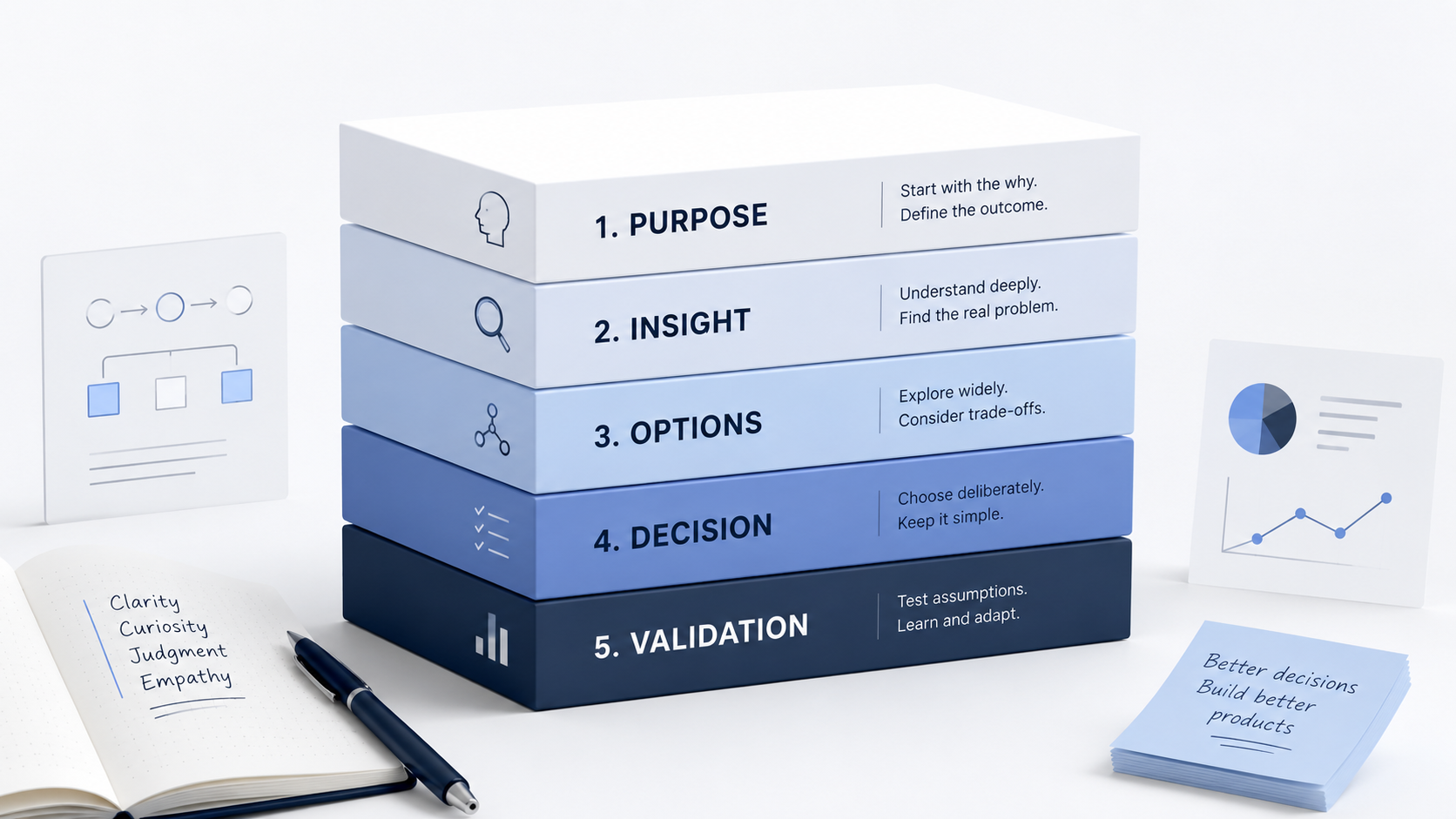
A useful AI operating model needs to sit between tool access and product action. Call it the PM Thinking Stack, with one important caveat: PMs do not own the whole stack alone. They anchor it. The team operates it.
Use the stack progressively. For an early prototype, start with the problem frame and the permission boundary. If those are unclear, do not spend energy polishing the demo. For a customer-facing beta, add context, evaluation, and acceptance criteria. For production, make the learning loop and governance explicit. Governance and accountability run through all six layers.
1. Problem and workflow frame
Start here before choosing a tool. What user, workflow, pain, or decision are we improving? What are the costs of delay and error? Why is AI better than a rule, search, form, dashboard, or ordinary automation?
This layer protects the team from tool-first thinking. It also creates the first go or no-go gate. If the workflow has low tolerance for error, unclear ownership, or no measurable value, adding AI will not fix it.
2. Context and evidence layer
AI output improves when the system has the right context. It gets worse when context is stale, partial, untrusted, or too broad. Ask: what customer, business, domain, technical, and organizational context does the system need? What sources can it use? How fresh must those sources be? What evidence must it show before users trust it?
This layer matters because many AI failures are not reasoning failures. They are context failures. The system answers from the wrong source, lacks the user’s situation, misses a policy, or treats outdated information as current.
3. Boundaries, permissions, and risk layer
Every AI workflow needs limits. Agentic workflows need them even more. What must the system never do? What data can it read? What systems can it write to? What actions need approval? What escalation, rollback, and logging must exist?
This layer turns abstract governance into product decisions. In a support workflow, for example, drafting a reply can sit inside a lightweight review step. Issuing refunds, changing account status, or sending regulated language needs a different permission model.
4. Evaluation and observability layer
A product team needs to know whether the system works before launch and whether it degrades after launch. What does good mean for this user and task? What examples represent excellent, acceptable, and failed output? What failure cases belong in the regression suite? What should we sample in production? What threshold triggers human review, rollback, or retraining?
This layer is the operating infrastructure for judgment. It turns taste, safety, usefulness, and trust into repeatable checks. Evals do not eliminate risk. They catch known failure modes, compare versions, and make quality visible. They still miss unknown edge cases, distribution shifts, and failures outside the test set. That is why observability and human review belong in the same layer.
5. Acceptance and action layer
AI output should connect to a decision. What action will this output inform? Who decides whether to accept it? What evidence do they need? Should the team ship, revise, reject, escalate, roll back, or stop?
This layer prevents AI from becoming a content machine with no accountability. A faster report only matters if someone decides what action follows. A better draft only matters if someone knows the acceptance standard. An agent only helps if the team knows when it can act without approval.
6. Production learning loop
AI quality changes after launch because users change, data change, models change, prompts change, and edge cases appear. How will we capture user feedback and record rejection reasons? What human override patterns matter? What incidents require eval updates? What model or prompt changes need regression tests?
This layer turns failure into institutional memory. Teams build advantage when expert rejection patterns become shared constraints, examples, and tests.
Cross-cutting layer: Governance and accountability
Governance is not a final review meeting. It has to run across the stack. For AI products, governance means documented ownership, auditability, model and vendor review, security, privacy, compliance, policy controls, and clear accountability for outcomes. NIST’s AI Risk Management Framework, the EU GPAI Code of Practice, and OpenAI’s Preparedness Framework all point in this direction: AI risk management is lifecycle work, not a one-time launch gate.
For PMs, the practical version is simple: never let “human in the loop” stay vague. Name the human. Name the authority. Name the review moment. Name the evidence. Name the escalation threshold.
Tool fluency still matters
This argument can be misread as “tools do not matter.” That is wrong. PMs need hands-on reps with LLMs, retrieval, automation, prototypes, evals, and agents. Junior PMs especially need to use the tools enough to understand their strengths, failure modes, and cost of review.
But tool fluency is the first layer, not the destination. A PM who knows how to prompt but cannot define success criteria will produce more plausible noise. One who can prototype but cannot state what the prototype proves will create false confidence. One who can spec an agent but cannot define permissions, escalation, and rollback will create risk faster than value.
The goal is to connect technical fluency to product judgment, not to become less technical. The more fluent you become with the tools, the harder it can be to keep enough distance to spot their failures. Tool fluency and acceptance discipline have to develop together.
The bottleneck moves upstream
AI can speed up some forms of generation, coding, research synthesis, and prototyping. It does not make execution cheap in every context. When AI increases output speed, the bottleneck often shifts to problem selection, workflow integration, evidence quality, review capacity, risk management, and stakeholder alignment. That is PM territory, but not exclusively. The PM’s value rises when they can help the team decide what is worth building, what is worth trusting, what is worth automating, and what is worth stopping.
This is where the stack has to stay pragmatic. Not every AI experiment needs the same weight. A hackathon prototype needs a clear user, a clear task, and a clear permission boundary. An internal copilot needs a lightweight rubric and a feedback path. A customer-facing agent in a regulated workflow needs deeper evals, monitoring, approvals, and rollback. The standard should scale with the risk. The habit should start early.
The gateways
Before you add AI to a workflow, pass through the problem gateway: does this workflow have a clear user, task, owner, success measure, and reason AI beats a simpler solution? Before you trust AI output, pass through the context gateway: can the team explain what sources, examples, rules, and prior decisions shaped the answer? Before you give a system autonomy, pass through the permission gateway: do you know what it can read, what it can change, what it must never do, and when a human must approve the next step? Before you launch, pass through the quality gateway: have you defined good and bad output with rubrics, examples, evals, human review, production monitoring, and rollback thresholds? Before you act on the output, pass through the decision gateway: who decides whether to ship, revise, reject, escalate, stop, or automate? Before you scale, pass through the learning gateway: will every failure, override, support issue, rejection pattern, and model change make the system easier to evaluate next time?
The PMs who win with AI will not be the ones with the longest tool list. They will be the ones who can make judgment operational. AI gives teams more output. The thinking stack decides what deserves to become product.